

 Sign in Next

 Български
 Čeština
 Dansk
Dansk
 Deutsch
 Eesti
Eesti
 Ελληνικά
 Español
 Français
 Hrvatski
 Italiano
 Latviešu
 Lietuvių
 Magyar
 Nederlands
 Norsk
Norsk
 Polski
 Português
 Română
 Slovenčina
 Slovenščina
 Српски (Ћирилица)
 Suomi
Suomi
 Svenska
 Türkçe
 Русский
 Українська
tables
Obligations of manufacturers of scented candles and diffusers in the EU under REACH and CLP
If you manufacture scented candles or diffusers and want to sell them in the EU, you have probably encountered abbreviations such as REACH, CLP or UFI. These regulations determine how products must be classified, labelled and when a notification to poison centres is required.
Do I need to prepare a Safety Data Sheet (SDS) for a candle or diffuser?
A Safety Data Sheet is prepared for products that are classified as hazardous or contain substances:
- persistent, bioaccumulative and toxic (PBT)
- very persistent and very bioaccumulative (vPvB)
- substances of very high concern (SVHC)
- substances with exposure limits (i.e. substances for which a maximum concentration in workplace air is defined)
The Safety Data Sheet is primarily provided to professional users. If you sell candles only to end consumers, you do not have to supply the Safety Data Sheet together with the product. However, you must have it prepared and provide it upon request.
For scented candles and diffusers, the following classification often results, for example:
- H317 (may cause an allergic skin reaction)
- H411/H412 (hazardous to the aquatic environment)
How do I find out whether my candle or diffuser is classified as hazardous?
To determine whether a product is hazardous, it is necessary to know its formulation, i.e. which substances it consists of. The formulation ensures the functionality of the product, for example that the candle or diffuser has a fragrance.
The hazard assessment is based on the input raw materials used, for which Safety Data Sheets should be available.
From these raw materials, the individual substances are identified and their concentration in the final product is recalculated. Based on this information, the classification of the product is then determined according to the rules of CLP.
The classification calculation is usually performed by a chemical regulatory specialist, or specialised tools can be used, for example the SBLCore software.
What should the packaging of a candle or diffuser contain according to the CLP Regulation?
If the candle or diffuser is classified as hazardous or contains sensitising substances, it must be packaged and labelled according to the CLP Regulation.
You cannot place the label directly on the candle wax because it is intended for burning. A hazardous candle must therefore be sold in packaging that directly contains the candle (for example glass or another container) on which the CLP label is placed.
The label must be firmly attached to the packaging, clearly visible and easy to read.
The same rules also apply to reed diffusers (rattan), which must also be labelled with a CLP label.
If the product also has outer packaging or a box, the required information must also be indicated on this packaging.
For candles and diffusers in small packages (e.g. under 125 ml), exemptions from certain labelling requirements may apply.
What a CLP label usually contains:
- product name
- hazard symbols (pictograms)
- signal word (Danger / Warning)
- H-statements (standard hazard statements)
- P-statements (precautionary statements)
- supplier details
- nominal quantity (for consumer packaging)
- UFI code if the product is subject to notification in the PCN system
In addition to CLP, products often also include safety pictograms according to the ČSN EN 15494 standard, which inform consumers about the correct use of candles (for example not leaving a burning candle unattended).
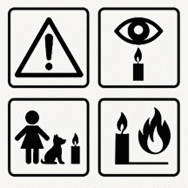
Illustrative image.
Do I need to report information about a candle or diffuser to PCN?
Yes, if the product is classified as hazardous to health or due to its physical properties (H2xx or H3xx), you must submit a notification to the PCN system (Poison Centres Notification). The notification must be submitted for each Member State where the product will be sold. One of the conditions for submission is the UFI code, which must also be indicated on the product label.
When do I need a UFI?
UFI (Unique Formula Identifier) is created for products that are subject to notification in the PCN system.
It is a sixteen-character alphanumeric code that links a specific product on the market with information about its composition included in the PCN notification. Thanks to this, poison centres in individual countries have access to information about the product composition in case of emergencies.
Online tools can be used to create a UFI, for example the UFI Generator on the ECHA website.
A UFI generator is also available on our website, where you can also find additional information about mixture notification to the PCN system.
Summary
As manufacturers of scented candles and diffusers, you must determine the classification of your product according to the CLP Regulation before placing it on the market. If the product is classified as hazardous or contains certain regulated substances, you must prepare a Safety Data Sheet. For hazardous products, it is also necessary to ensure correct packaging and labelling according to CLP. If the product is classified as hazardous to health or due to its physical properties, you must submit a notification to the PCN system and indicate the UFI code on the label.

© 2026 SBLCore

